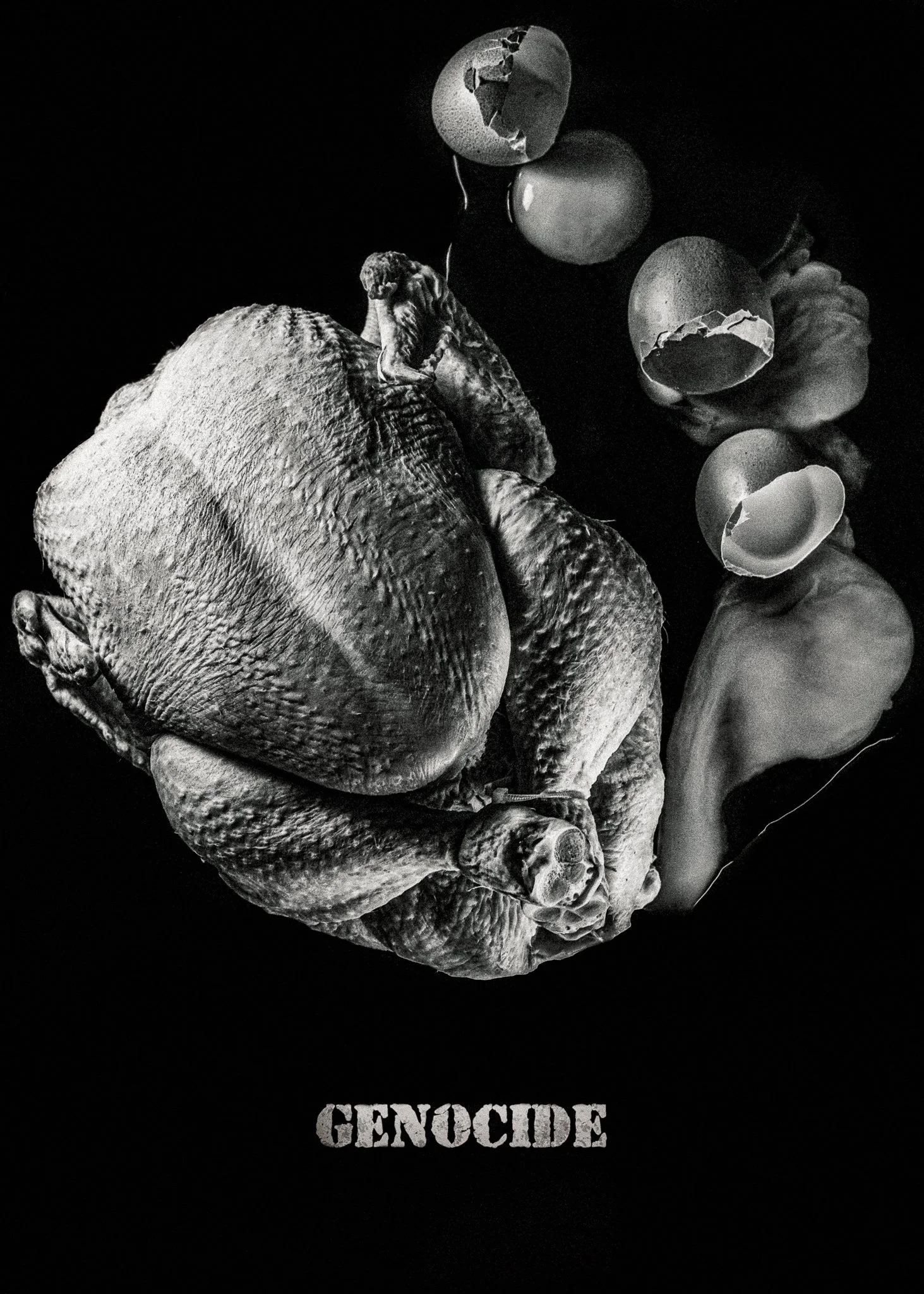
ANOTHER GEONOCIDE IN BROAD LIGHT: Still life. Barcelona, 2025
EN
Magritte painted a pipe and wrote beneath it: this is not a pipe. He was pointing at the gap between representation and reality. The image is not the thing.
I tried the opposite.
The image doesn't look like what the word says. But it is exactly what the word says.
This chicken is, technically, a genocide. A species killed en masse. Eggs destroyed before they became anything. An entire lineage ended at industrial scale, every day, without record or ceremony.
The word beneath the image is not wrong. It is accurate.
And yet when we read genocide we expect Srebrenica. Gaza. Rwanda. Human bodies. Human suffering. The word arrives with an asterisk we never agreed to put there.
Genocide * of humans. The ones that count.
I wasn't making a political statement. I wasn't vegetarian or vegan when I made this. I was breading chicken for dinner, dipping it in eggs and breadcrumbs, when the thought arrived uninvited. That origin matters. An activist making this image would be making propaganda. I made it by accident, and the accident is where the meaning lives.
What interests me is the opposite of my work as a marketer, where the aim is to communicate something by depicting something. Here, ambiguity is the mechanism. The viewer stops. Pauses. Reassesses what they're seeing, because a context is implied that the image refuses to confirm.
The chicken exposes that asterisk by fulfilling the definition while violating the expectation.
Magritte was playing with semiotics. This image plays with moral categorisation dressed as semiotics. The betrayal isn't between the word and the image. It's inside the word itself.
We built a hierarchy into language and forgot we built it.
ES
Magritte pintó una pipa y escribió debajo: esto no es una pipa. Señalaba la brecha entre la representación y la realidad. La imagen no es la cosa.
Yo intenté lo contrario.
La imagen no parece lo que dice la palabra. Pero es exactamente lo que dice la palabra.
Este pollo es, técnicamente, un genocidio. Una especie masacrada. Huevos destruidos antes de convertirse en nada. Un linaje entero terminado a escala industrial, cada día, sin registro ni ceremonia.
La palabra debajo de la imagen no está equivocada. Es exacta.
Y sin embargo, cuando leemos genocidio esperamos Srebrenica. Gaza. Ruanda. Cuerpos humanos. Sufrimiento humano. La palabra llega con un asterisco que nunca acordamos poner.
Genocidio * de humanos. Los que cuentan.
No estaba haciendo una declaración política. No era vegetariano ni vegano cuando hice esto. Estaba rebozando pollo para cenar, pasándolo por huevo y pan rallado, cuando el pensamiento llegó sin avisar. Ese origen importa. Un activista haciendo esta imagen estaría haciendo propaganda. Yo la hice por accidente, y el accidente es donde vive el significado.
Lo que me interesa es lo contrario de mi trabajo como marketero, donde el objetivo es comunicar algo representando algo. Aquí, la ambigüedad es el mecanismo. El espectador se detiene. Hace una pausa. Revalúa lo que está viendo, porque se insinúa un contexto que la imagen se niega a confirmar.
El pollo expone ese asterisco cumpliendo la definición mientras viola la expectativa.
Magritte jugaba con la semiótica. Esta imagen juega con la categorización moral disfrazada de semiótica. La traición no está entre la palabra y la imagen. Está dentro de la palabra misma.
Construimos una jerarquía en el lenguaje y olvidamos que la construimos.