El 11 de noviembre
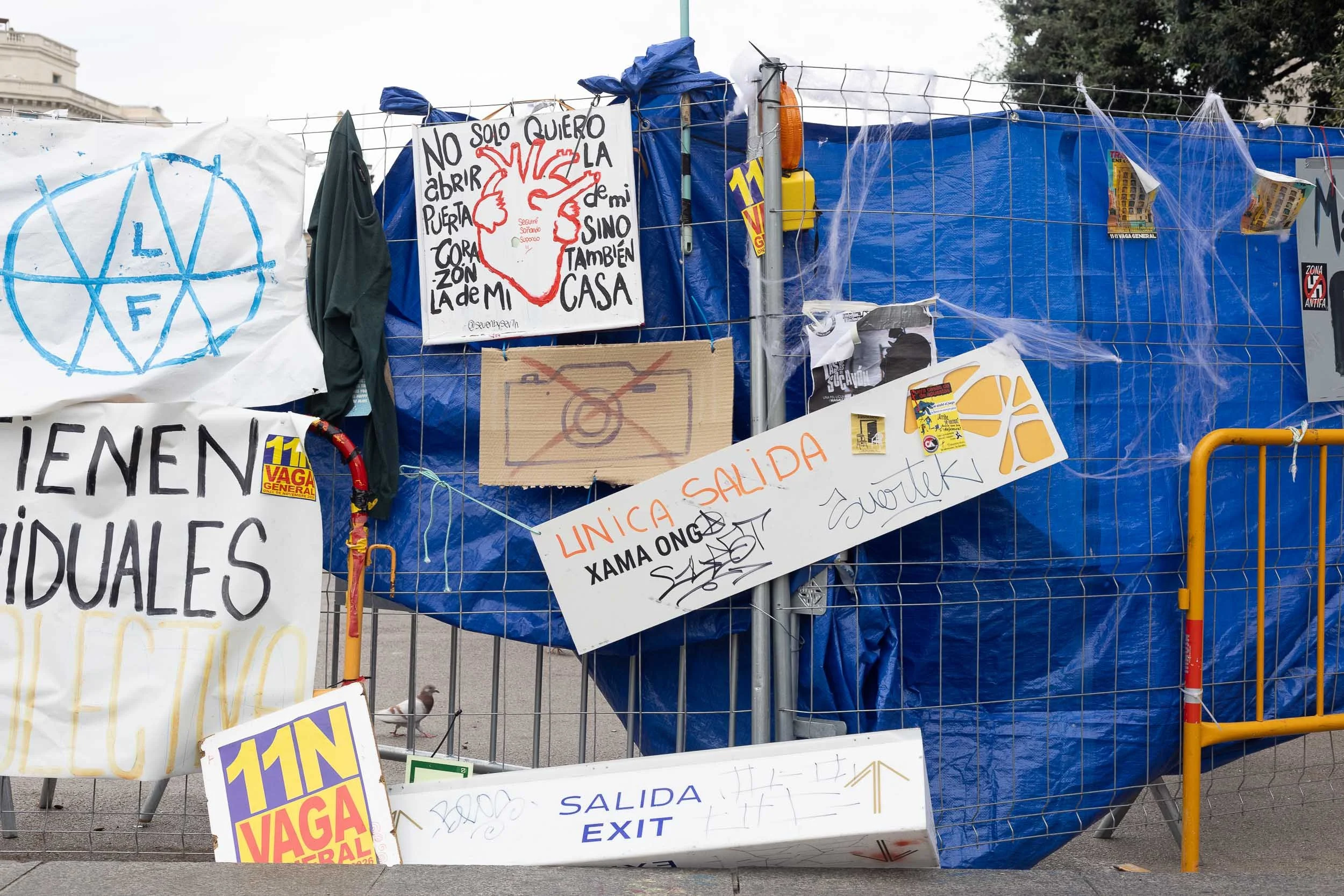
Imagen de la acampada en la Plaça de Catalunya.
El 11 de noviembre estaba en la calle, en Barcelona. Ese día hubo huelga general por la vivienda y por los salarios, la primera con los sindicatos mayoritarios en 14 años. Era un día que me esperaba: el punto de ruptura llevaba semanas manifestándose y ese día la rabia encontró su lugar y su día.
Como en toda multitud, había partes distintas. Quienes marchaban detrás de una pancarta y quienes volcaban su rabia detrás de un pasamontañas. Las lunas de Geox y H&M fueron de las que se rompieron; las de Philipp Plein y Dior se quedaron intactas. Al otro lado estaban la tensión y el miedo, tan humanos, de enfrentarse a algo que no se puede planear ni entrenar, porque es tu trabajo. La mejor foto no pude hacerla: un antidisturbios en su furgón, fumando un vape, un instante antes del momento X. No todos volvieron a casa ilesos.
Sobre las cifras no hay acuerdo. Los organizadores hablan de unas 400.000 personas en la manifestación de Barcelona; la Guàrdia Urbana, la policía municipal, de 55.000. Sobre el seguimiento de la huelga en Cataluña, CCOO dice el 84%; las patronales Pimec y Cecot, menos del 10%. Yo no tengo contador. Tengo una cámara y lo que vi.
Escribo de vivienda porque de ahí venía esa movilización. Es la misma rabia que documenté en Nepal el año pasado: busca manifestaciones distintas para decir lo mismo. Quería entender qué hay debajo. Este texto es lo que encontré.
Hong Kong, diez metros cuadrados
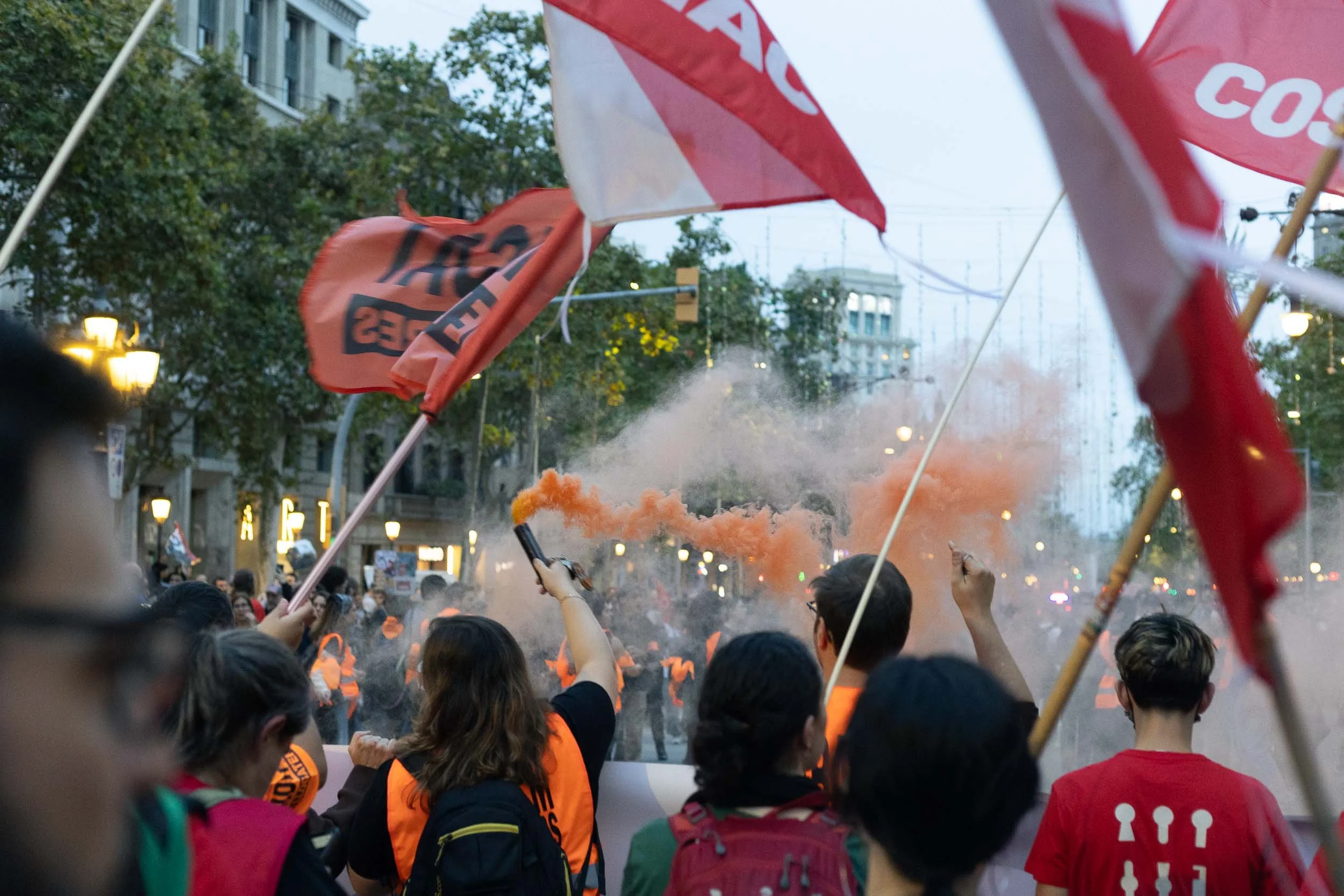
Bengalás al anochecer y fuego en la calle.
Wandering Focus 105 es una pasarela con escaleras mecánicas, en Hong Kong. Arriba la gente camina, abajo pasa una calle estrecha, detrás un edificio está envuelto en la red verde de una obra. Una ciudad estrecha y vertical, donde el espacio es lo más escaso.
Hong Kong tiene 7,5 millones de habitantes y usa unos 80 kilómetros cuadrados de suelo para viviendas. El precio lo dice una cifra: en la última edición de la encuesta Demographia, una vivienda media cuesta 14,1 años de ingresos brutos de un hogar, y es la ciudad menos asequible del mundo por decimosexto año consecutivo. En 2021 la relación era 23,2 y los precios han bajado más de un 20% desde el máximo. Sigue entre las más altas del planeta.
Cuando la vivienda cuesta así, se divide. Según los datos que AP publicaba en febrero de 2025, unos 110.000 pisos se han subdividido en unidades más pequeñas y viven en ellas unas 220.000 personas. La unidad mediana mide unos 10 metros cuadrados, una plaza de aparcamiento mide 12,5, y el alquiler mediano es de 5.000 dólares de Hong Kong al mes, unos 640 dólares estadounidenses. Son menos del 3% de los habitantes. No es la norma de toda la ciudad. Es la solución de una parte de quienes no encuentran otra cosa.
Y no es una ciudad sin Estado. El 29% de la población vive en viviendas públicas de alquiler, unos 2,16 millones de personas, y la espera media para conseguir una es de 4,8 años. Las reglas sobre las unidades subdivididas llegaron después: desde 2022 una protección para quien alquila, con contratos más estables y límites a las subidas en la renovación, y luego estándares mínimos de superficie, seguridad, ventilación y servicios, aprobados el 26 de septiembre de 2025 y en vigor desde el 1 de marzo de 2026. Los controles empiezan en marzo de 2027, con 36 meses de tolerancia desde esa fecha. En Hong Kong las reglas existen. Llegaron cuando el espacio dividido ya era un mercado.

Bengalás al anochecer y fuego en la calle.
Barcelona, la misma escena
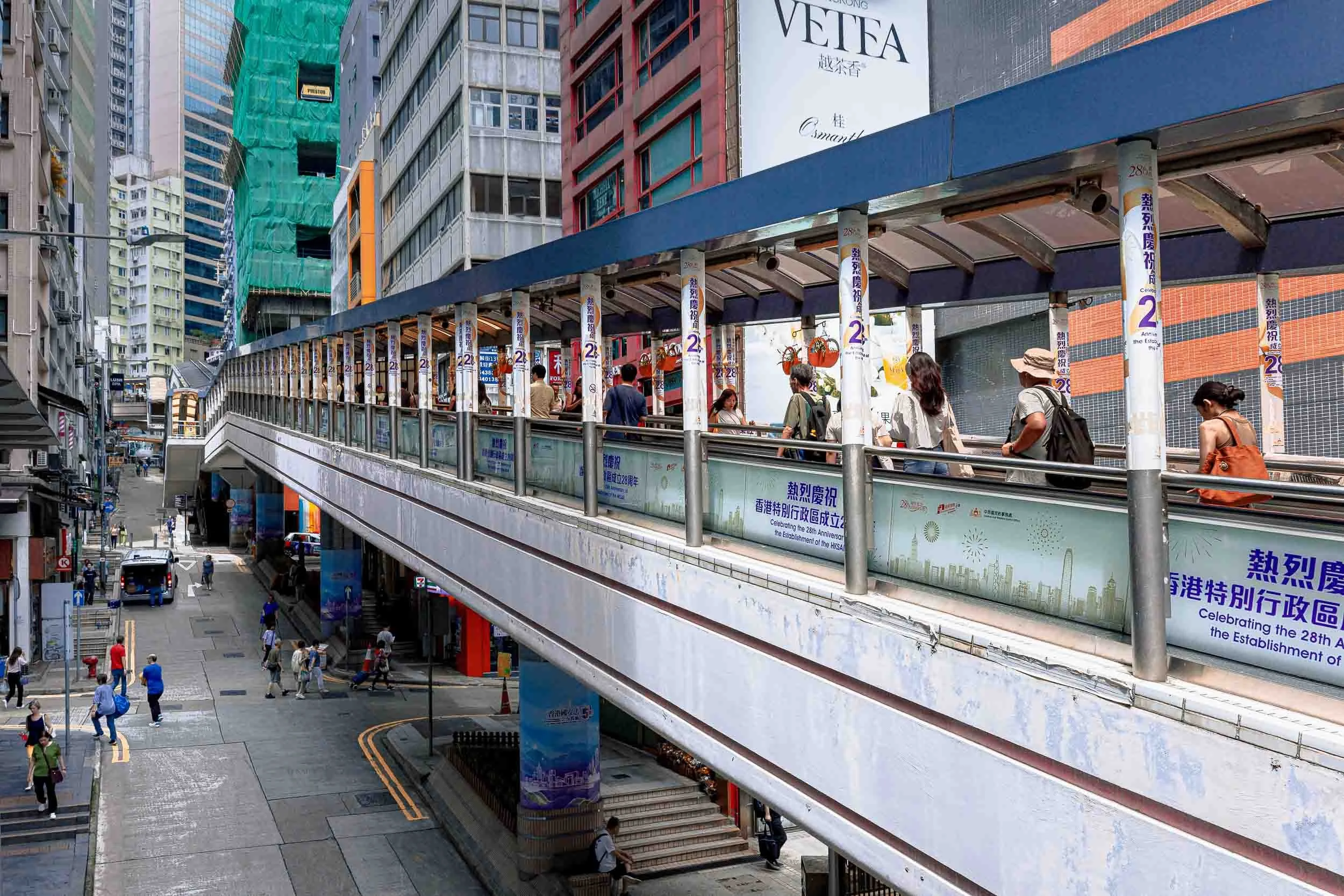
Para algunas personas, en esta ciudad el hogar mide diez metros cuadrados. Hong Kong, China. 2025.
Vivo en la Barceloneta. La escala es distinta, la escena se reconoce. En el segundo trimestre de 2026, una habitación en alquiler en Barcelona costaba de media 650 euros al mes, un 8,3% más que un año antes, según HousingAnywhere. En Madrid, 600 euros. En Europa, en conjunto, los precios de las habitaciones bajaban un 4,6%.
En Hong Kong se divide el piso en unidades; en Barcelona se alquila por habitaciones. Es el mismo movimiento: cuando el precio supera el sueldo, se divide. Dublín, Milán y Barcelona son tres ciudades que conozco, y veo el mismo guión.
La pregunta sigue siendo la misma en todas: quién puede permitirse una vivienda entera, y quién no.
Qué pedía la calle

En esta ciudad una habitación cuesta de media 650 euros al mes. Barcelona, España. 2026
El 11 de noviembre no se pedía una sola cosa. El Sindicat de Llogateres, el sindicato de inquilinas e inquilinos, pedía recuperar las viviendas vacías, frenar los apartamentos turísticos y las compras especulativas, aumentar la vivienda pública, parar los desahucios y cambiar la Constitución para que el derecho a la vivienda prevalezca sobre la libertad de empresa. CCOO y UGT llevaban salarios y poder adquisitivo. Entre los lemas de la manifestación: «Ni gente sin casa ni casas sin gente».
No todos leyeron la jornada igual. Algunos sectores la calificaron de política, porque se convocó en vísperas de una campaña electoral, y los convocantes se desmarcaron de los partidos. Aquí cuento qué se pedía, no quién tenía razón.
Qué dicen los números
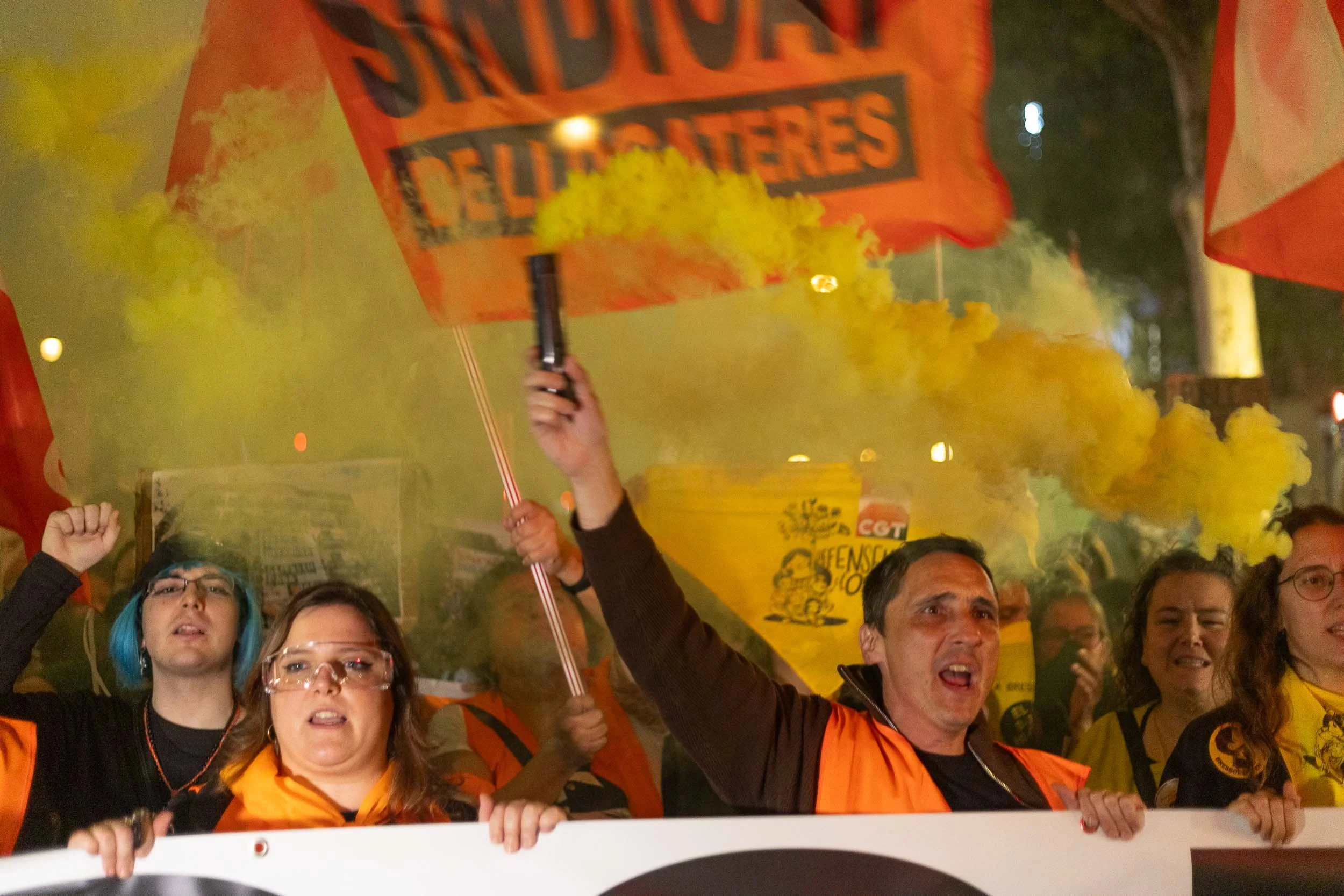
El sindicato de inquilinas marchó entre humo amarillo. Barcelona, España. 2026
Según el Banco de España, en España faltan 750.000 viviendas: es el déficit acumulado en cinco años, de 2021 a 2025. En un solo año se formaron 240.000 hogares nuevos y se terminaron 92.000 viviendas. El banco espera que el déficit siga creciendo, porque la inmigración y los hogares nuevos siguen fuertes mientras construir sigue siendo difícil.
En España la vivienda pública pesa muy poco: es el 1,5% del total según los Gestores Administrativos, en torno al 1,2% según la OCDE. En los Países Bajos es el 34% según la OCDE, entre el 20 y el 30% según otras estimaciones. Las definiciones cambian de una fuente a otra, pero el orden de magnitud no. En Hong Kong, las viviendas públicas de alquiler son alrededor del 29% de las viviendas.
¿Y construir sirve? Un estudio de Evan Mast, Brian Asquith y Davin Reed analizó los grandes edificios de mercado libre, de 50 apartamentos o más, en barrios de renta baja de Estados Unidos. Los alquileres pedidos en las cercanías bajaron entre un 5 y un 7% frente a zonas comparables. El efecto es real y moderado. Son anuncios, no contratos firmados, y son barrios estadounidenses. Sobre Barcelona, el estudio no dice nada.
Por qué construir no basta por sí solo

Detrás de los altavoces.
Las dos recetas no se excluyen. Por el lado de la oferta, los obstáculos para construir son la burocracia, las normas superpuestas entre ayuntamientos, comunidades autónomas y Estado, la planificación lenta y la falta de mano de obra especializada. Quienes salieron a la calle insisten en otra pregunta: quién puede permitirse lo que se construye.
Hong Kong muestra lo difícil que es. Tiene un Estado que da vivienda al 29% de la población, una presión enorme sobre el suelo y 220.000 personas en espacios de diez metros cuadrados. Ni siquiera allí una sola palanca ha cerrado la distancia.
Los números dicen que construir ayuda. Aquí empieza la discusión de verdad: cuántas viviendas, qué viviendas, para quién. El mercado por sí solo no llega a quien tiene poco poder adquisitivo, porque construye donde se paga más.
Antes de creer al siguiente
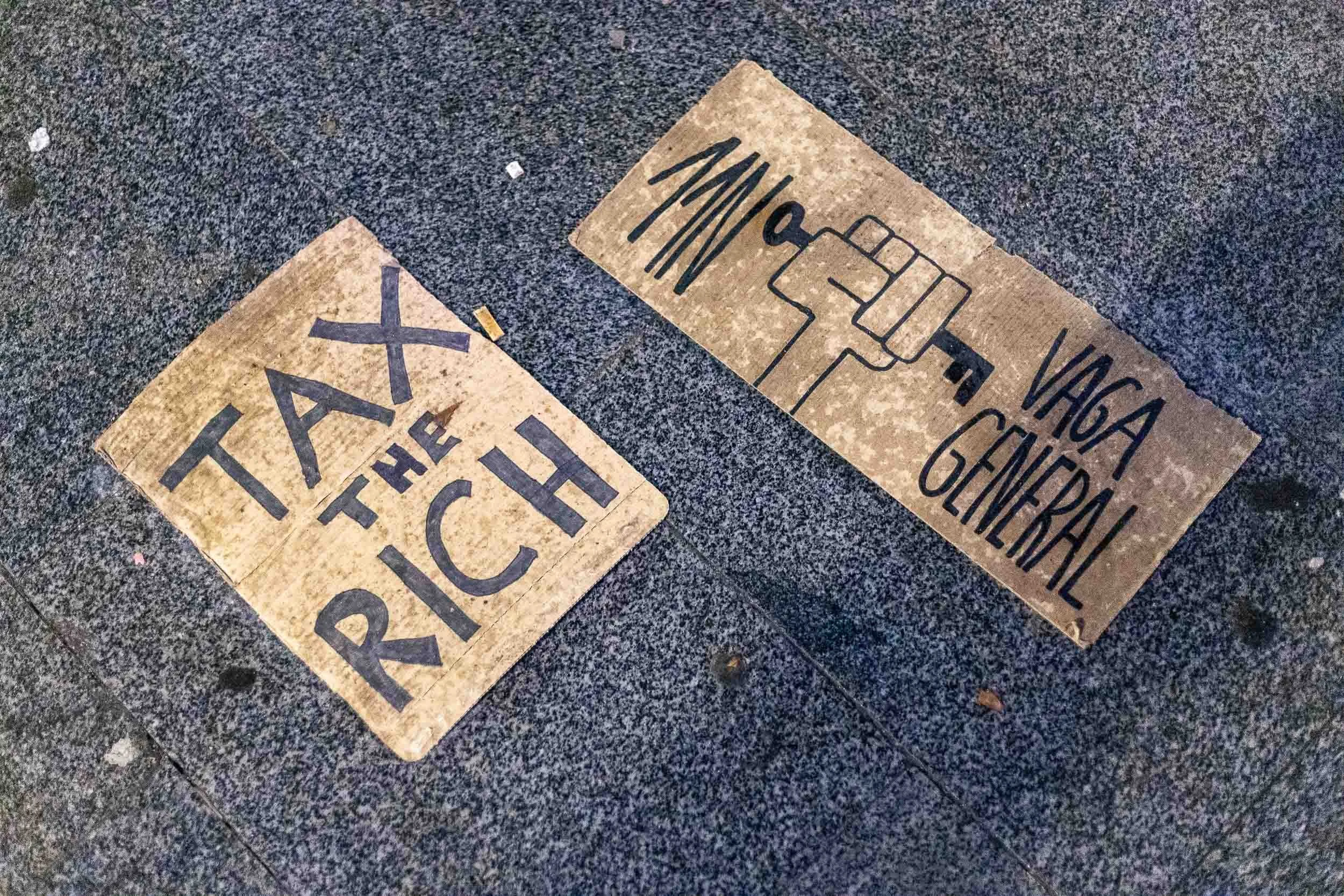
Un puño cerrado sobre una llave, en el suelo. Barcelona, España. 2026
He escrito este texto pensando en quién vota y vive esta historia en carne propia: quien busca una habitación, quien no puede irse de la de sus padres, quien paga un alquiler que pesa demasiado.
No os digo por quién votar. Os pido que tenáis presentes tres preguntas cuando alguien os prometa la solución.
¿Qué viviendas?
¿Para quién?
¿Pagadas por quién y a qué precio?
El encantador de serpientes tiene una sola melodía y la toca bien. Quien os ofrece una sola solución os está vendiendo la mitad de la respuesta.
Un agujero de 750.000 viviendas no se formó en un año y no se cierra en un año. Recordadlo cuando llegue el siguiente que prometa cerrarlo en un año.
Fuentes
Comprobadas el 23 de noviembre de 2026.
11 de noviembre
Ara, The keys to an unprecedented general strike: quién convocó, reivindicaciones, cifras de la manifestación y del seguimiento
Ara, The most transversal general strike makes a cry for housing: reivindicaciones de los sindicatos, contexto electoral
Ara, Massive protest and strike at half throttle: 55.000 según la Guàrdia Urbana, detenidos
Catalan News, Thousands gather in Barcelona for unified general strike demonstration: 400.000 según los organizadores, lemas, disturbios
El Salto, CCOO eleva la participación en la huelga general en Catalunya al 84%: 84% según CCOO, Pimec y Cecot
Hong Kong
HKSAR Government, Basic housing units bill passed: estándares mínimos, fechas de entrada en vigor
Inquirer (AP), Why some Hong Kongers live in homes smaller than a parking space: 110.000 unidades, 220.000 personas, tamaños y alquileres, 80 km² (artículo del 14 de febrero de 2025)
The Standard, HK remains world’s least affordable housing market for 16th year: relación precio ingresos 14,1 (Demographia)
Hong Kong Yearbook 2024, Housing: 29% de la población en viviendas públicas de alquiler, protección de los contratos de alquiler desde 2022. La cuota de en torno al 29% de las viviendas es un cálculo sobre 866.500 viviendas públicas de alquiler de un total de 3.033.900
Housing Bureau, Composite Waiting Time: espera de 4,8 años a finales de junio de 2026
España
elDiario.es, El Banco de España eleva a 750.000 las viviendas que faltan: déficit 2021 2025, 240.000 hogares y 92.000 viviendas en un año
Euronews, El Banco de España señala un déficit de 750.000: obstáculos para construir
Democrata, España solo tiene un 1,5% de vivienda pública: 1,5%, 1,2% OCDE, Países Bajos 34% (OCDE) y entre el 20 y el 30% (otras estimaciones)
Qué!, Alquilar una habitación en España: 650 euros en Barcelona, segundo trimestre de 2026 (HousingAnywhere)
Upjohn Institute, New apartment buildings in low-income areas decrease nearby rents: estudio de Mast, Asquith y Reed
Will building more homes bring rents down?
11 November
Plaça de Catalunya fence with the heart sign: Not only the door of the heart. Also the door of the home. Barcelona, Spain. 2026
On 11 November I was out on the street in Barcelona. That day there was a general strike over housing and wages, the first with the main unions in 14 years. It was a day I saw coming: the breaking point had been showing for weeks, and that day the anger found its place and its day.
Like every crowd, this one had its parts. Those who marched behind a banner and those who poured their anger out behind a balaclava. The windows of Geox and H&M were among the ones that broke; Philipp Plein’s and Dior’s stayed intact. On the other side were the tension and the very human fear of facing something you cannot plan or train for, because it is your job. The best photo I could have taken I could not take: a riot police officer in his van, vaping, a moment before moment X. Not everyone walked home unhurt.
There is no agreement on the numbers. The organisers speak of about 400,000 people at the Barcelona march; the Guàrdia Urbana, the municipal police, of 55,000. On how many joined the strike in Catalonia, CCOO says 84%, the employers’ groups Pimec and Cecot less than 10%. I don’t have a counter. I have a camera and what I saw.
I write about housing because that is where the mobilisation came from. It is the same anger I documented in Nepal last year: it looks for different manifestations to say the same thing. I wanted to understand what lies underneath. This piece is what I found.
Hong Kong, ten square metres
Dusk, then night. Barcelona, Spain. 2026
Wandering Focus 105 is a covered walkway with escalators in Hong Kong. People walk above, a narrow street runs below, and behind them a building is wrapped in the green netting of a construction site. A narrow, vertical city where space is the scarcest thing.
Hong Kong has 7.5 million people and uses about 80 square kilometres of land for housing. One number tells you the price: in the latest Demographia survey, an average home costs 14.1 years of a household’s gross income, and it is the least affordable city in the world for the sixteenth year running. In 2021 the ratio was 23.2, and prices have fallen more than 20% from the peak. It is still among the highest on the planet.
When housing costs that much, it gets divided. According to the figures AP reported in February 2025, about 110,000 flats have been split into smaller units, and about 220,000 people live in them. The median unit measures about 10 square metres, a parking space measures 12.5, and the median rent is HK$5,000 a month, about US$640. That is under 3% of residents. It is not the norm for the whole city. It is the solution for some of the people who can’t find anything else.
And this is not a city without a state. 29% of the population lives in public rental housing, about 2.16 million people, and the average wait to get a place is 4.8 years. The rules on subdivided units came later: from 2022 a protection for tenants, with more stable contracts and limits on rent rises at renewal, then minimum standards for size, safety, ventilation and services, approved on 26 September 2025 and in force from 1 March 2026. Checks start in March 2027, with 36 months of grace from that date. In Hong Kong the rules exist. They arrived when the divided space was already a market.
Fires set up by protesters. Barcelona, Spain. 2026.
Barcelona, the same scene
For some people in this city, home measures ten square metres. Hong Kong, China. 2025
I live in Barceloneta. The scale is different, the scene is recognisable. In the second quarter of 2026 a room to rent in Barcelona cost 650 euros a month on average, 8.3% more than a year earlier, according to HousingAnywhere. In Madrid, 600 euros. Across Europe as a whole, room prices were falling by 4.6%.
In Hong Kong flats are divided into units; in Barcelona they are rented by the room. It is the same move: when the price goes beyond the salary, you divide. Dublin, Milan and Barcelona are three cities I know, and I see the same script.
The question stays the same in all of them: who can afford a whole home, and who can’t.
What the street was asking for
In this city a room costs 650 euros a month on average. Barcelona, Spain. 2026
On 11 November there was not one demand. The Sindicat de Llogateres, the tenants’ union, asked to recover empty homes, stop tourist flats and speculative purchases, increase public housing, stop evictions and change the Constitution so that the right to housing prevails over freedom of enterprise. CCOO and UGT brought wages and purchasing power. Among the march’s slogans: “Neither people without homes nor homes without people.”
Not everyone read the day the same way. Some sectors called it political, because it was called on the eve of an election campaign, and the organisers distanced themselves from the parties. Here I report what was asked, not who was right.
What the numbers say
The tenants' union marched in yellow smoke. Barcelona, Spain. 2026
According to the Banco de España, Spain is short of 750,000 homes: that is the deficit accumulated over five years, from 2021 to 2025. In a single year 240,000 new households formed and 92,000 homes were completed. The bank expects the deficit to keep growing, because immigration and new households stay strong while building stays difficult.
In Spain public housing weighs very little: it is 1.5% of the total according to the Gestores Administrativos, around 1.2% according to the OECD. In the Netherlands it is 34% according to the OECD, between 20 and 30% according to other estimates. Definitions change from source to source, but the order of magnitude does not. In Hong Kong, public rental flats are about 29% of homes.
Does building help? A study by Evan Mast, Brian Asquith and Davin Reed looked at large market-rate buildings, 50 apartments or more, in low-income neighbourhoods in the United States. Asking rents nearby fell by 5 to 7% compared with similar areas. The effect is real and moderate. These are listings, not signed leases, and they are American neighbourhoods. On Barcelona, the study says nothing.
Why building alone is not enough
Speaker with raised fist. Barcelona, Spain. 2026
The two recipes do not exclude each other. On the supply side, the obstacles to building are bureaucracy, overlapping rules between town halls, regions and the state, slow planning and a shortage of skilled labour. Those who took to the streets insist on another question: who can afford what gets built.
Hong Kong shows how hard it is. It has a state that houses 29% of the population, enormous pressure on land, and 220,000 people in spaces of ten square metres. Even there, a single lever has not closed the gap.
The numbers say building helps. This is where the real discussion starts: how many homes, which homes, for whom. The market alone does not reach those with little purchasing power, because it builds where people pay more.
Before believing the next one
Cardboard signs on the ground.
I wrote this piece thinking of those who vote and live this story first hand: people looking for a room, people who can’t leave their parents’ home, people paying rent that weighs too much.
I won’t tell you who to vote for. I’m asking you to keep three questions in mind when someone promises you the solution.
Which homes?
For whom?
Paid for by whom, and at what price?
The snake charmer has one melody, and plays it well. Whoever offers you a single solution is selling you half the answer.
A hole of 750,000 homes did not form in a year and will not close in a year. Remember that when the next one comes along promising to close it in a year.
Sources
Checked on 23 November 2026.
11 November
Ara, The keys to an unprecedented general strike: who called it, demands, march and turnout figures
Ara, The most transversal general strike makes a cry for housing: the unions’ demands, election context
Ara, Massive protest and strike at half throttle: 55,000 according to the Guàrdia Urbana, arrests
Catalan News, Thousands gather in Barcelona for unified general strike demonstration: 400,000 according to the organisers, slogans, clashes
El Salto, CCOO eleva la participación en la huelga general en Catalunya al 84%: 84% according to CCOO, Pimec and Cecot
Hong Kong
HKSAR Government, Basic housing units bill passed: minimum standards, dates of entry into force
Inquirer (AP), Why some Hong Kongers live in homes smaller than a parking space: 110,000 units, 220,000 people, sizes and rents, 80 km² (article of 14 February 2025)
The Standard, HK remains world’s least affordable housing market for 16th year: price to income ratio 14.1 (Demographia)
Hong Kong Yearbook 2024, Housing: 29% of the population in public rental housing, tenancy protection since 2022. The share of about 29% of homes is my calculation from 866,500 public rental flats out of 3,033,900
Housing Bureau, Composite Waiting Time: 4.8 year wait at the end of June 2026
Spain
elDiario.es, El Banco de España eleva a 750.000 las viviendas que faltan: deficit 2021 to 2025, 240,000 households and 92,000 homes in one year
Euronews, El Banco de España señala un déficit de 750.000: obstacles to building
Democrata, España solo tiene un 1,5% de vivienda pública: 1.5%, 1.2% OECD, Netherlands 34% (OECD) and 20 to 30% (other estimates)
Qué!, Alquilar una habitación en España: 650 euros in Barcelona, second quarter of 2026 (HousingAnywhere)
Upjohn Institute, New apartment buildings in low-income areas decrease nearby rents: study by Mast, Asquith and Reed